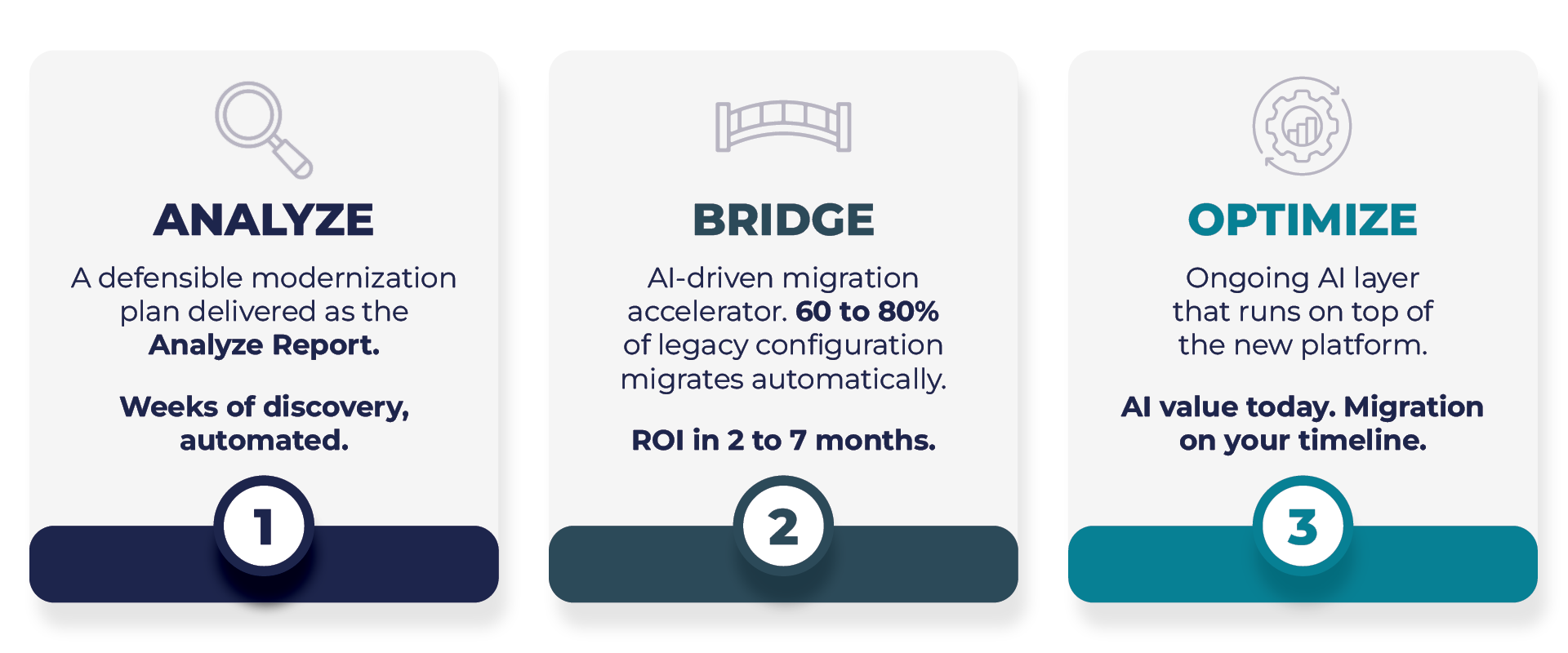
The modernization conversation usually starts with the platform. The customer conversation starts with the journey. What runs in production today? How does the migration actually happen? What does the new platform look like once it is live? What keeps it improving after that? Modernization runs as a three-stage SentieroAI journey including Analyze, Bridge, and Optimize, with Tungsten TotalAgility providing the orchestration layer. This model ensures that that operations run smoothly and continue to approve once the migration is complete.
For customers running the migration, that looks like:
- Operations leaders needing visibility into what is working and what is degrading before any migration scope is approved
- IT architects needing a defensible plan for moving years of fine-tuning into a new platform without losing it
- Risk and compliance teams needing audit-ready chain of custody through every stage, not just the destination
[Download the full banking automation white paper] to see the full journey end to end, with the proof points behind each stage.
The Three Stages, End to End
Banking modernization runs as a three-stage SentieroAI journey. Analyze, Bridge, and Optimize are owned by Zia’s purpose-built SentieroAI, with Tungsten’s TotalAgility serving as the destination platform that orchestrates document-driven operations at enterprise scale.
SentieroAI is the intelligence layer across the journey. It diagnoses the current state, builds the modernization roadmap, executes the migration, identifies additional use cases, and tunes the operation after go-live. TotalAgility is the destination platform. It runs the bank’s document-driven workflows at enterprise scale once the migration is complete. TotalAgility is the platform banks move to. SentieroAI is the fastest path to it, and the layer that keeps it improving once they are there.
The same three stages apply whether a bank is moving up from legacy automation or expanding inside an existing TotalAgility footprint. The journey is the same. The starting point is what differs.
Stage 1: Analyze (SentieroAI)
Modernization decisions go wrong when they start with assumptions instead of evidence. Stage 1 closes that gap before any migration decision is made.
SentieroAI Analyze scans the existing automation environment. That includes legacy capture configurations, batch classes, custom scripting, integration points, and operational metrics. It generates an AI-driven assessment of what is working, what is not, and where the highest-value modernization opportunities sit.
The output is a prioritized roadmap, not a sales deck. Banks see which document types and workflows are performing well, which are degrading, where automation gaps exist, and where AI investment will generate the strongest return.
For banks running legacy platforms, Analyze runs against the existing environment. For banks already on TotalAgility, Analyze runs against the existing workflows: how they perform, where exceptions concentrate, and where the platform connects to adjacent systems that could be brought into scope next. The result is the same in both cases: a defensible, data-backed modernization plan before a single migration decision is made.
For banks engaging through Tungsten Automation’s Move Up program, SentieroAI Analyze serves as the equivalent of the program’s Phase 0 Discovery Engagement, delivered at no cost by Zia rather than a typical paid assessment.
Turnaround is 24 hours from engagement to a full read of the environment, with cost-benefit analysis and a ranked roadmap.
Stage 2: Bridge (SentieroAI)
SentieroAI Bridge is Zia’s migration accelerator. It operates inside Tungsten Automation’s Move Up program and is the stage that practitioners care most about, because it is where the technical risk of migration actually concentrates.
Bridge automates up to 60 to 80 percent of the legacy configuration transfer into TotalAgility (or InvoiceAgility for AP-focused workloads). That includes batch classes, document classifications, extraction rules, regex logic, and trained models. Many document types migrate and reach 100 percent automation.
The legacy capture environment continues to operate in parallel with the modern platform for the full length of the initial contract term. Each migrated workflow can be validated side by side before the original system is retired. Bridge applies AI enhancements in flight, automatically integrated into TotalAgility. Documents that previously required manual review for handwriting, cursive, or non-standard layouts are processed by TotalAgility for classification, separation, extraction, and workflow orchestration. The exception layer shrinks immediately.
Investment protection is intentional. Years of fine-tuning in the legacy environment are preserved rather than rebuilt. Trained models, document classifications, extraction rules, and regex logic all carry forward into TotalAgility. The bank does not rebuild what already works.
Bridge engagements are scoped to deliver measurable ROI in 4 to 7 months, against a traditional replatforming benchmark of a year or more. The economics shift because the parallel-run model removes the cutover risk that drives traditional replatforming timelines.
The Destination: Orchestration on TotalAgility
Once SentieroAI Bridge completes its work, TotalAgility takes over as the operational platform that runs the bank’s document-driven workflows at enterprise scale. The first deployment runs on it. Every subsequent expansion runs on it.
TotalAgility brings six capabilities together in a single platform:
- Document Ingestion. Every document, regardless of channel, enters through a governed intake layer rather than an ad-hoc workaround.
- Intelligent Document Processing. Classification and extraction at the point of entry using 3,000+ pre-trained models, with 95 percent extraction accuracy on document types that previously routed heavily to exception queues.
- Workflow, Orchestration, and RPA. Documents are routed, reviewed, and acted on consistently by rule rather than individual judgment.
- AI, ML, and Agentic Capabilities. LLM integration, NLP, and agentic orchestration operate inside the governed platform. For banks deploying AI in KYC, AML, or lending decisions, these capabilities run inside the model risk management framework rather than as shadow AI outside of it.
- Integration and Security. 100+ enterprise system connections, full audit trails, RBAC, encryption, and chain-of-custody controls built into every document transaction from arrival through final disposition.
- Deployment and Analytics. On-premises, cloud, and air-gapped environments supported, with real-time SLA monitoring and disaster recovery.
Orchestration is not a project. It is an operational capability that compounds over time. SentieroAI gets you to TotalAgility. TotalAgility runs your operation.
Stage 3: Optimize (SentieroAI)
Migration is not the finish line. Once TotalAgility is live, SentieroAI Optimize is the layer that sits on top of the running platform and keeps it improving. Banks extend the platform into new use cases as part of operational rhythm rather than as separate projects. New document types are onboarded as they appear. Workflows are monitored in real time. AI-driven optimization surfaces opportunities to tighten accuracy and reduce exceptions, so the operation gets better the longer it runs, not just at go-live.
This is the stage that separates SentieroAI from a one-time migration project. Orchestration is what the platform does. Optimize is what Zia keeps doing on top of it.
How the Three Stages Map to the Two Paths
The three stages map cleanly onto the two banking modernization paths.
Migrating banks run Analyze and Bridge through SentieroAI, move their operation onto TotalAgility, then run Optimize on top of it. The journey covers all three SentieroAI stages in sequence.
Expansion banks run a targeted Analyze on each new use case through SentieroAI, then bring that workflow onto TotalAgility and fold it into Optimize. Stage 2 Bridge is light or skipped entirely because most integration work is already done.
Both paths converge on the same operational platform. The architectural pattern compounds the same way regardless of starting point. See our blog, Two Paths to AI-Driven Automation for Banks, for the strategic framing on which path fits a given bank.
Proof: Bridge in Banking Production
A Top 15 US Bank ran lending operations on a manual, document-heavy intake process. Multiple disconnected systems. Slow file pickup. Rising operational cost. An initial attempt to replace the existing capture system with a fully AI-driven application proved prohibitively expensive and fell short on automation capability.
The bank has partnered with Zia to deploy SentieroAI Bridge with Tungsten TotalAgility. Bridge is migrating the existing capture environment automatically while preserving prior document training and configurations. TotalAgility is extending automation across lending, onboarding, and operations.
The engagement is expected to deliver an 80 percent reduction in manual effort, more than $575,000 in annual savings ($2.05 million over five years), 15 million documents processed annually, and break-even in 8 months with ROI inside the first year. Implementation is on an approximately 16-week timeline.
The pattern is operationally significant for practitioners. The initial “replace everything” approach failed on cost and capability grounds. The phased migration approach through Bridge worked because it preserved the investment already in the legacy environment, applied AI enhancements in flight, and avoided the rip-and-replace risk that stalls most modernization efforts.
Why This Matters
- Stage 1: Analyze produces a defensible modernization roadmap in 24 hours, not weeks of paid discovery
- Stage 2: Bridge migrates up to 60 to 80 percent of legacy configuration automatically and delivers ROI within the first year
- TotalAgility brings six platform capabilities into one governed environment
- Stage 3: Optimize identifies additional use cases and tunes it after go-live
- The legacy and modern platforms run in parallel for the full initial contract term, eliminating the rip-and-replace risk
Why Zia Runs This Journey
Zia’s banking practice is anchored on Ephesoft-to-TotalAgility migrations, with Kofax Capture and Kofax Transformation in active scope. Every migration produces edge case knowledge (document variability across regions, integration patterns to core banking platforms, audit-trail requirements across regulators) that compresses the timeline from a year-plus to 4 to 7 months.
Zia works closely with Tungsten Automation across the Move Up program, which means SentieroAI is deployed against migrations Zia has already run, not theorized about. Tungsten Automation serves 8 of the 10 largest global banks and 1,800 banking partners across 76 countries. The architectural pattern works at the top of the banking league tables. The Analyze, Bridge, Optimize journey is how it scales to banks that are not yet there.
Schedule a SentieroAI Analyze Assessment
The modernization journey starts with Stage 1. Stage 1 starts with a SentieroAI Analyze assessment that produces a defensible read of the current environment in 24 hours, with cost-benefit analysis and a ranked roadmap.
Download the full banking automation white paper to see the entire journey mapped against the regulatory environment, the proof points, and the modernization arc. Then schedule a SentieroAI Analyze assessment with Zia. The roadmap is yours either way.
Revisit our Banking Use Cases at Scale: Where AI-Driven Automation Lands First for the use case sequencing behind the journey.
Frequently Asked Questions
What Is the SentieroAI Modernization Journey?
The SentieroAI modernization journey is a three-stage path that moves banks from legacy automation onto Tungsten TotalAgility. Stage 1 (Analyze) diagnoses the current environment and produces a prioritized roadmap. Stage 2 (Bridge) migrates up to 60 to 80 percent of legacy configuration automatically. Stage 3 (Optimize) identifies use cases and keeps the bank’s workflows improving after go-live, with TotalAgility providing the orchestration layer the operation runs on.
How Long Does Each Stage of the Journey Take?
Stage 1 Analyze produces a full assessment in 24 hours. Stage 2 Bridge engagements are scoped to deliver measurable ROI in 4 to 7 months, against a traditional replatforming benchmark of a year or more. Stage 3 Optimize is an ongoing operational rhythm rather than a fixed-duration project; new use cases plug into the existing platform as the bank expands.
What Gets Migrated Automatically by SentieroAI Bridge?
SentieroAI Bridge automates up to 60 to 80 percent of the legacy configuration transfer into TotalAgility (or InvoiceAgility for AP-focused workloads). That includes batch classes, document classifications, extraction rules, regex logic, and trained models. Some document types migrate and reach 100 percent automation. The legacy environment runs in parallel with TotalAgility for the full initial contract term.
What Capabilities Does TotalAgility Provide After Migration?
Tungsten TotalAgility brings six capabilities into one platform: Document Ingestion, Intelligent Document Processing (with 3,000+ pre-trained models and 95 percent extraction accuracy), Workflow and Orchestration and RPA, AI/ML/Agentic Capabilities inside the model risk management framework, Integration and Security with 100+ enterprise connectors, and Deployment and Analytics across on-premises, cloud, and air-gapped environments.